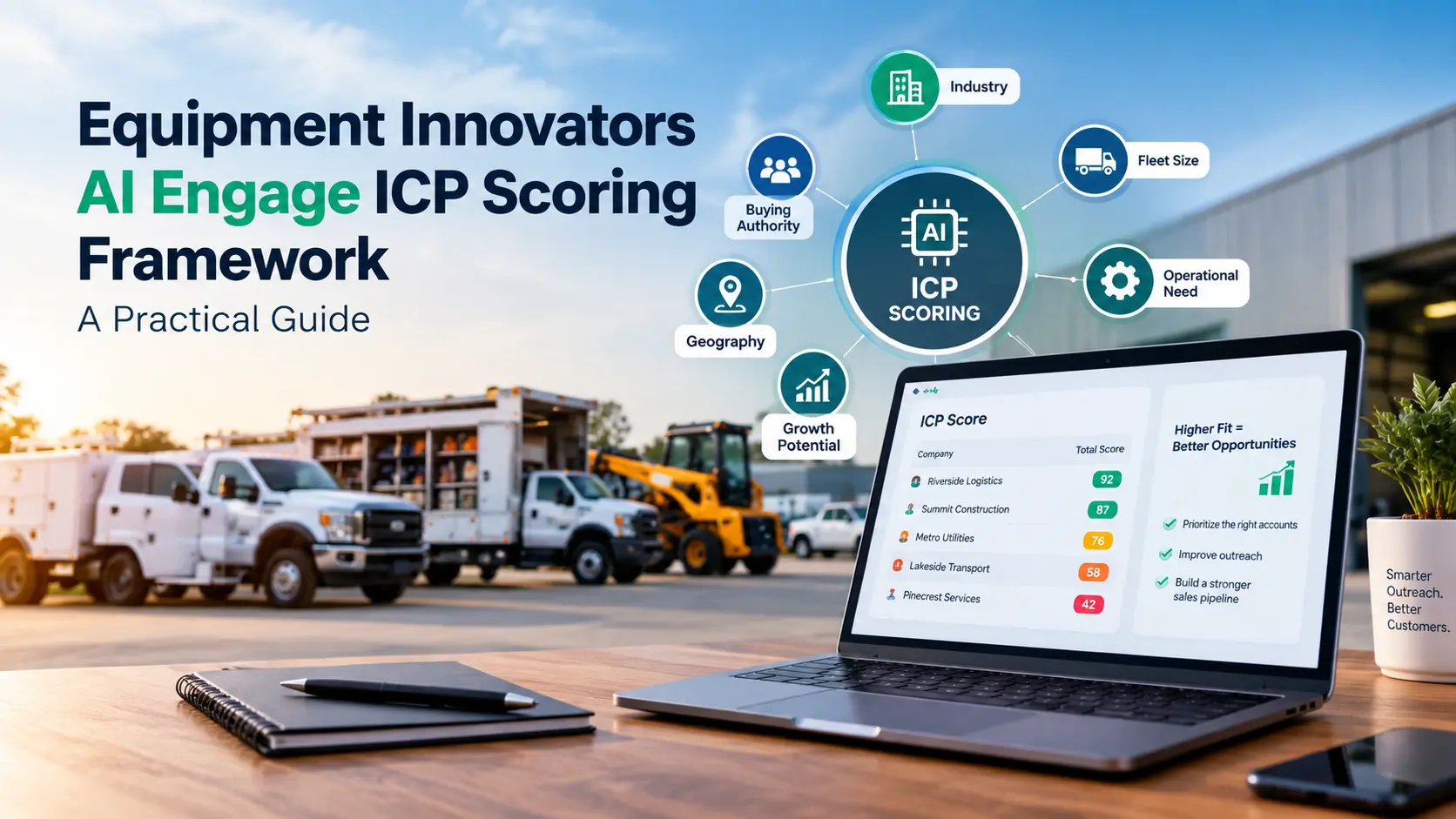
Custom equipment manufacturers do not need more leads. They need more of the right leads. Equipment Innovators AI Engage ICP Scoring Framework should be used. A sales team can waste weeks pursuing companies that lack the budget, fleet size, operational need, or buying authority to justify a complex equipment purchase. At the same time, a strong-fit account can go cold simply because no one recognized its potential soon enough.
An AI-enabled ideal customer profile (ICP) scoring framework helps solve that problem. It gives equipment innovators a repeatable way to identify, prioritize, and engage accounts that most closely match their best customers.
This guide explains how to build an ICP scoring framework for a custom vehicle-body, fleet-equipment, or industrial manufacturing business.
What Is an ICP Scoring Framework?
An ICP scoring framework assigns a value to a company based on how closely it matches your ideal customer profile.
Your ICP is not just a job title or a broad industry. It describes the types of companies that receive the most value from your product and are most likely to become profitable, successful customers.
For a custom equipment manufacturer, a high-fit account may have:
- A field-service or mobile operations model
- A fleet that needs specialized vehicle configurations
- Multiple locations or regional growth plans
- A clear need for secure storage, mobile workspaces, vending, delivery, repair, or utility operations
- A budget and procurement process for custom equipment
- An operational leader who can influence the buying decision
ICP scoring helps your team sort accounts into a clear order of priority.
Why Equipment Manufacturers Need Better Account Prioritization
Complex equipment sales often involve longer buying cycles, multiple stakeholders, customization requirements, and significant capital decisions.
That makes broad outreach expensive.
If a sales representative treats every company as equally valuable, the team spends too much time researching poor-fit prospects and too little time helping companies with a real operational need.
An ICP scoring framework improves focus by helping teams:
- Identify the accounts most likely to benefit from custom equipment
- Route high-potential accounts to sales faster
- Tailor outreach to real business challenges
- Reduce low-value prospecting activity
- Improve marketing and sales alignment
- Learn which account characteristics predict closed-won revenue
The goal is not to let AI decide who deserves a conversation. The goal is to give people better evidence before they invest time.
ICP Scoring vs. Lead Scoring
Teams often confuse ICP scoring with lead scoring. They measure different things.
ICP scoring measures account fit. It asks, “Is this company the kind of customer we serve best?”
Lead scoring measures engagement and buying activity. It asks, “Is this person or account showing interest now?”
A company may be an excellent ICP fit but not actively researching solutions today. Another company may download a brochure but lack the fleet, budget, or operational need to become a good customer.
Use both scores together:
| Score type | Main question | Example signals |
|---|---|---|
| ICP fit | Is this the right account? | Industry, fleet size, operating model, geography, growth |
| Intent or engagement | Is there interest now? | Website activity, event attendance, quote requests, hiring signals |
| Opportunity readiness | Can the account buy? | Budget, timeline, decision-makers, active project |
The best sales teams do not chase activity alone. They prioritize fit, intent, and readiness.
The Five-Part ICP Scoring Framework
A useful framework for equipment innovators should evaluate five categories.
1. Operational Fit
Start with the operational problem your equipment solves.
Ask:
- Does the company run a mobile or distributed workforce?
- Does it rely on service vehicles, delivery vehicles, utility fleets, or field operations?
- Does it need secure equipment storage, mobile inventory, or a specialized work environment?
- Does the company serve customers at job sites, in remote locations, or across a territory?
A high operational-fit score means your product solves a visible business problem.
2. Company Capacity
A strong use case does not always mean a strong commercial opportunity. Score the company’s ability to purchase and scale.
Consider:
- Fleet size
- Number of locations
- Employee count
- Revenue range, where available
- Replacement or expansion cycle
- Regional or national footprint
A company with one vehicle may still be a valuable customer, but a company with a growing fleet can represent a larger long-term opportunity.
3. Industry and Use-Case Match
Not every industry uses custom equipment in the same way.
Create specific use-case segments rather than relying on a vague “target industries” list. For example, your best-fit groups may include companies that need mobile vending, field repair, utility work, last-mile services, specialized delivery, or on-site technical support.
Score each industry based on real customer outcomes, not assumptions.
Review your closed-won customers. Look for patterns in:
- Industry
- Vehicle type
- Equipment configuration
- Contract value
- Sales cycle length
- Repeat purchase rate
- Referral potential
This turns your ICP into a business asset instead of a marketing guess.
4. Buying Readiness
A strong-fit account needs a reason to act.
AI and sales research can help identify signals such as:
- Fleet expansion
- New service locations
- Hiring for field operations
- New contracts or territory growth
- A new distribution model
- Mergers, acquisitions, or facility expansion
- Job postings for fleet, operations, logistics, or field-service roles
Do not treat one signal as proof of a purchase. Use it as a reason to research further and start a relevant conversation.
5. Contact and Access Quality
Even the best account requires the right people.
Score the quality of available contacts based on:
- Job function
- Seniority
- Connection to fleet, operations, procurement, or business development
- Ability to influence the purchase
- Availability of accurate contact information
For complex equipment purchases, one contact is rarely enough. Build a small account map that includes operational leaders, fleet managers, procurement contacts, finance stakeholders, and executive sponsors.
A Sample ICP Scoring Model
Use a 100-point score to keep the model simple and explainable.
| Category | Maximum points | What to score |
|---|---|---|
| Operational fit | 30 | Mobile workforce, fleet needs, custom-equipment use case |
| Company capacity | 20 | Fleet scale, locations, growth potential |
| Industry and use-case match | 20 | Proven fit with your strongest customer segments |
| Buying readiness | 20 | Expansion, hiring, fleet changes, active project signals |
| Contact quality | 10 | Relevant decision-makers and usable account access |
Then create clear tiers:
- 80–100: Priority accounts — Assign to sales for focused research and personalized outreach.
- 60–79: Develop accounts — Add to relevant campaigns and monitor for buying signals.
- 40–59: Nurture accounts — Educate through useful content and review later.
- Below 40: Low priority — Do not spend high-touch sales time unless new signals emerge.
Your team should adjust these thresholds after reviewing real pipeline results.
Where AI Adds Value
AI can speed up research and make account scoring more consistent. It can review public company information, summarize operational clues, classify industries, identify potential use cases, and flag changes that may suggest growth.
For example, an AI workflow can help a sales team:
- Gather public company data from approved sources
- Identify industry, locations, fleet-related roles, and growth signals
- Compare the account against defined ICP criteria
- Produce an explainable fit score
- Suggest research questions for a sales representative
- Route priority accounts into the CRM for human review
AI should support judgment, not replace it.
Do not allow a scoring model to rely on sensitive personal data, protected characteristics, or unverified assumptions. Keep the scoring criteria focused on business relevance and review the model regularly for errors.
Turn Scores Into Better Outreach
A score does not create pipeline by itself. Your team must use the information behind the score.
Avoid generic messages such as, “We help businesses like yours improve operations.”
Instead, connect the outreach to a credible operational hypothesis:
- “Your team appears to be expanding field-service coverage in three new markets. Are you evaluating how to standardize vehicle storage and mobile workspace requirements?”
- “We noticed your company is hiring fleet and service technicians. Are vehicle configurations creating any challenges for tool access, inventory, or technician productivity?”
- “As your delivery footprint grows, are you exploring custom body configurations that improve organization, access, or on-road efficiency?”
These messages work because they focus on a potential business need, not a superficial personalization trick.
How to Improve the Framework Over Time
Your first ICP model will not be perfect. Treat it as a working system.
Every quarter, compare your scores with actual results:
- Which score range created the most qualified opportunities?
- Which industries converted best?
- Which signals appeared before high-value deals?
- Which accounts looked ideal but never progressed?
- Which low-scoring accounts became strong customers?
Then adjust the weights.
If fleet scale predicts success more reliably than employee count, give fleet scale more weight. If a specific use case produces the strongest repeat business, make it a higher-priority segment.
This feedback loop makes the framework more useful over time.
Common ICP Scoring Mistakes
Avoid these errors:
- Using only firmographic data: Company size and industry do not reveal the full operational need.
- Scoring every account the same way: Different products or use cases may need different ICP models.
- Treating AI output as fact: Verify important claims before acting on them.
- Ignoring low-scoring accounts forever: New buying signals can change account value.
- Using scores without a sales process: Scores must trigger clear actions, ownership, and follow-up.
- Making the model too complex: A simple, explainable model that people use is better than an advanced model no one trusts.
Final Thoughts
An AI-enabled ICP scoring framework gives equipment innovators a more disciplined way to focus sales and marketing effort.
Start with the real characteristics of your best customers. Score operational fit, company capacity, industry match, buying readiness, and contact quality. Use AI to accelerate research, but keep people responsible for judgment and outreach.
When you treat ICP scoring as a living business system—not a one-time spreadsheet—you can spend less time chasing weak opportunities and more time building relationships with the companies you are best equipped to serve.