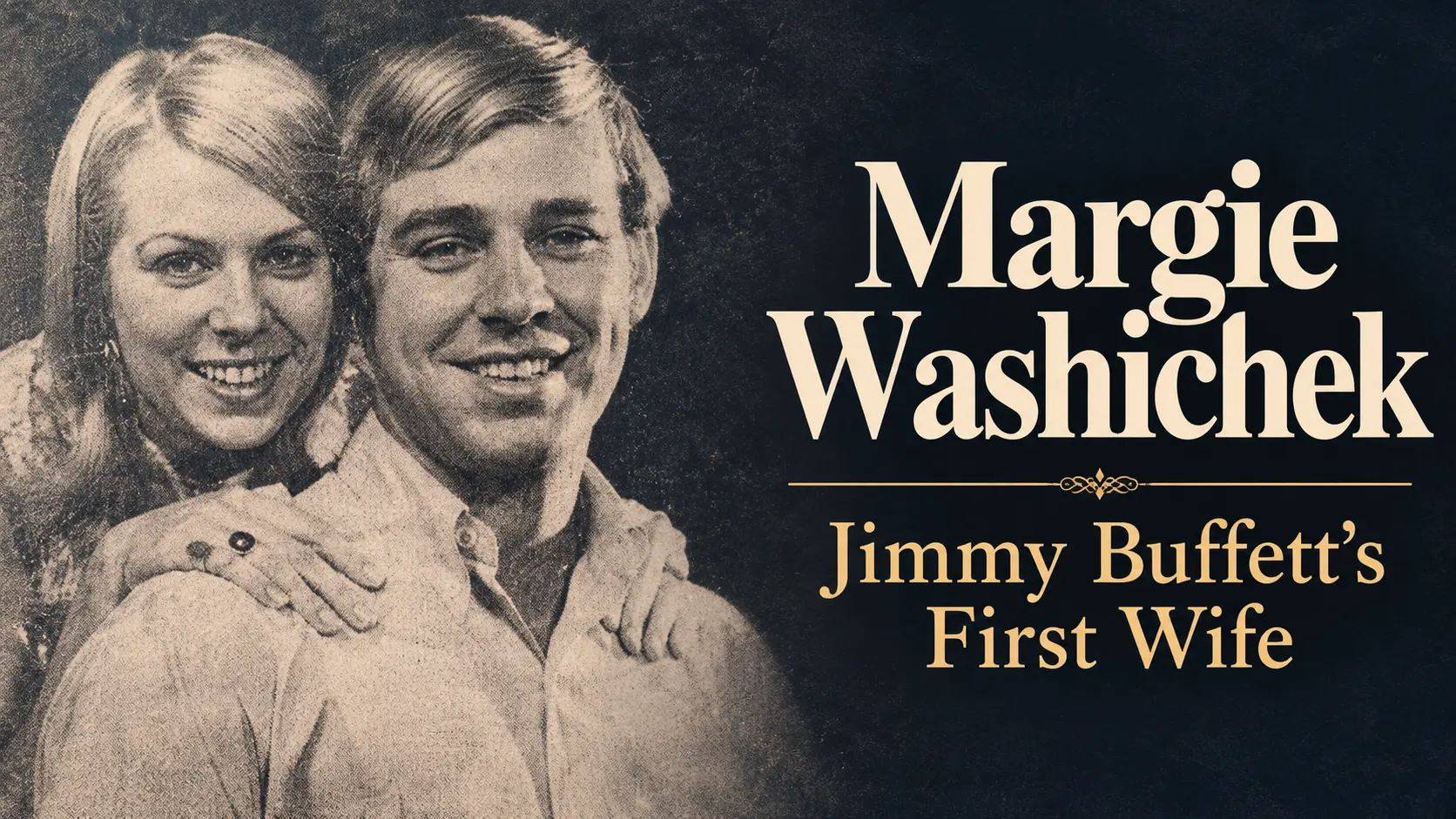
Margie Washichek was Jimmy Buffett’s first wife. They married in 1969, during the years when he was trying to establish himself as a recording artist. Their relationship belonged to the period before “Margaritaville,” when his professional life centered on local performances, recording opportunities, and the hope of finding an audience.
Washichek also had a public identity in Mobile, Alabama, beyond her relationship with Buffett. She attended Spring Hill College and held the title of Miss USS Alabama. Accounts from that period connect her directly to his early musical ambitions, including arranging a studio appointment and offering opinions on his songs. Those details provide a more personal picture of her than the familiar description “Jimmy Buffett’s first wife.”
Margie Washichek’s Connection to Mobile and Spring Hill College
Spring Hill College is an important part of Washichek’s documented background. Maritime historian John Sledge, writing in Mobile Bay magazine, identifies her as a Spring Hill graduate in his account of Buffett’s early adulthood. The college would also become the setting for their wedding.
Her activities placed her within Mobile’s community life before Buffett became nationally famous. A July 21, 1969, Mobile Press article by Lee Haug, preserved in an online transcription, identified her as a former Miss USS Alabama, an Azalea Trail maid, and a participant in Gayfer’s Teen Board modeling activities.
These are specific, identifiable activities. They offer a firmer starting point for understanding her early life than broad descriptions of her personality or childhood. They also show that local readers had reasons to recognize her name independently of the musician she had just married.
Her Miss USS Alabama Title
Washichek’s Miss USS Alabama title predates her marriage. A newspaper clipping indexed by Newspapers.com places coverage of her selection in the Panama City News on July 17, 1967. The title is also mentioned in the later Mobile Press account of the newly married couple.
The distinction is worth identifying precisely. “Miss USS Alabama” is the documented title; calling her simply “Miss Alabama” would imply a different honor.
For readers encountering her name through Buffett, this earlier recognition adds useful context. Her public story did not begin with his eventual celebrity. She already appeared in regional coverage during the late 1960s, and the marriage announcement could refer to activities that Mobile readers were expected to remember.
How She Helped Arrange an Early Recording Opportunity
One of the clearest accounts of Washichek’s involvement in Buffett’s early career comes from songwriter Milton Brown.
In a first-person recollection published by Our Southern Souls in March 2021, Brown remembered Washichek visiting Product Sound Studio to arrange an appointment for her fiancé. That fiancé was Buffett, then a student at Mississippi Southern. Brown recalled meeting him, recording his songs, and trying to interest local radio stations in the material.
Brown’s account describes the difficulty of finding a place for Buffett’s music. Stations did not readily know how to categorize his sound. The familiar identity that later connected him with beach life and tropical storytelling had yet to become his commercial calling card.
Washichek’s appointment is a small but concrete part of that history. It establishes practical involvement without requiring an exaggerated claim that she discovered Buffett or directed his career. Arranging access to a studio was a meaningful action at a time when recording and being heard were immediate challenges.
Brown subsequently helped pursue opportunities in Nashville and recalled that Buffett and Washichek moved there. His testimony connects her with the transition from local musical activity to an attempt at a professional recording career.
What Margie Said About Buffett’s Music
The 1969 Mobile Press account also preserves Washichek’s perspective on their relationship.
According to the surviving transcription, she described herself as someone who listened critically to Buffett’s songs before he presented them more widely. She gave him her opinion while recognizing that the final creative decision belonged to him. She also expressed confidence in his musical future.
That account gives substance to the idea that she encouraged him. Her involvement included listening and responding to work in progress, rather than simply appearing beside him after a performance.
It also captures the uncertainty of the moment. The newspaper was introducing a musician with a new professional opportunity, not celebrating an established star. Washichek’s confidence was expressed before the career outcomes that later made those early years interesting to a much larger audience.
Their 1969 Wedding and Life in Nashville
Washichek and Buffett married in 1969 at St. Joseph’s Chapel on the Spring Hill College campus in Mobile, according to the Encyclopedia of Alabama.
Nashville was the next important setting in their shared history. Buffett’s official biography describes his efforts there as a folk-country singer, alongside employment at Billboard magazine. His debut record, Down to Earth, appeared in 1970.
Those circumstances matter when considering the marriage. This was the beginning of a recording career, with ordinary employment still part of Buffett’s working life. The successful touring operation and business interests associated with his later name belonged to a different period.
Sledge’s Mobile Bay account describes the first album’s disappointing sales and Buffett’s eventual departure from Nashville. It places the short marriage within those unsettled early years, when professional direction and personal circumstances were changing together.
When Did Margie Washichek and Jimmy Buffett Divorce?
The marriage ended in the early 1970s, but published references do not agree completely on the year.
Biography.com lists their marriage as lasting from 1969 to 1972. The Encyclopedia of Alabama, however, places the divorce in 1971. Without an original divorce record establishing the legal timeline, that disagreement should remain visible rather than being converted into a supposedly certain date.
The encyclopedia links difficulties in the marriage with Buffett’s financial and professional disappointments in Nashville. That is a published biographical interpretation, not a complete account from both spouses. It cannot establish everything that happened privately between them.
Another chronological distinction concerns Key West. Buffett’s official biography dates his formative visit with Jerry Jeff Walker to 1971. His connection to the island should therefore not automatically be described as something that began after a conclusively established 1972 divorce. The visit and the legal end of a marriage are separate events.
Her Marriage Came Before “Margaritaville”
The timing explains why Washichek occupies a distinct place in Buffett’s biography.
His official career account places the chart success of “Come Monday” in 1974 and “Margaritaville” in 1977. Both came after the period covered by his first marriage. The latter song helped bring him national fame and eventually supplied the name for his expanding business interests.
Washichek’s documented connection is consequently strongest in the earlier material: Mobile, studio appointments, newly written songs, and the move toward Nashville.
That context also prevents a misleading financial picture. Being married to Buffett at the start of his career does not establish that she shared in the wealth associated with his later commercial success.
Was Margie the Mother of Buffett’s Children?
Buffett’s three children—Savannah, Sarah Delaney, and Cameron—belong to his family with his second wife, Jane Slagsvol. People identifies the three as children he shared with Jane, while his official obituary names Jane and the children among his surviving family. They should not be attributed to Washichek.
This distinction answers a common point of confusion without making broader assumptions about Washichek’s own family history. Buffett’s later family does not establish whether she had children or another marriage after their separation.
What Is Known About Her Later Life and Net Worth?
The historical accounts discussed here do not establish Washichek’s current residence, occupation, relationship status, or personal finances. A present-day biography cannot responsibly turn that absence into a detailed story about where she lives or how she spends her time.
It also cannot establish her reasons for remaining outside subsequent coverage. Descriptions of her as deliberately rejecting fame, choosing solitude, or avoiding all publicity assign motives that these accounts do not demonstrate.
There is likewise no substantiated net-worth figure to report. Her former husband’s later fortune is not evidence of her assets, income, or any divorce settlement.