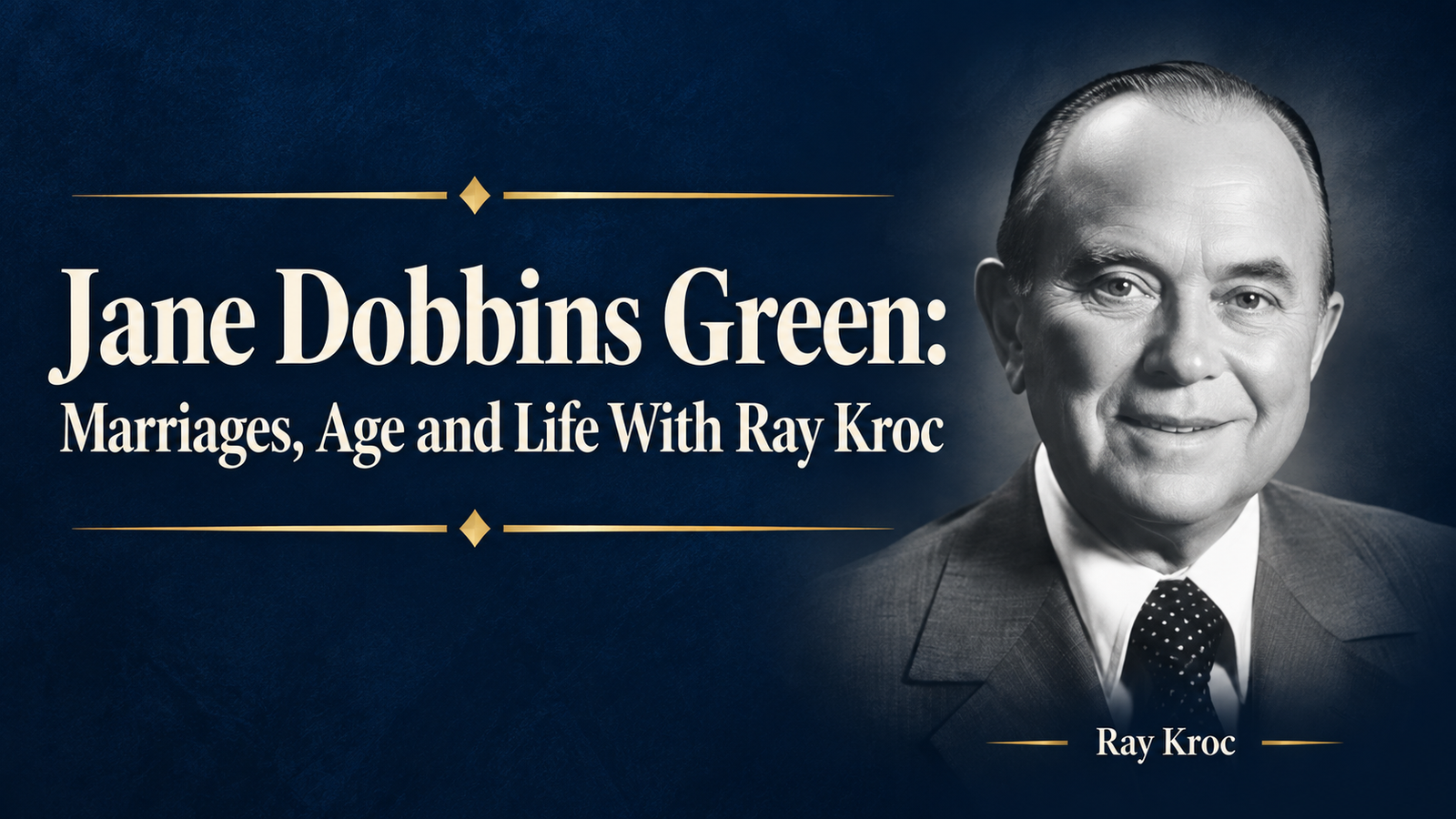
Jane Dobbins Green was the second wife of Ray Kroc, the businessman who helped expand McDonald’s into an international restaurant chain. They were married from 1963 to 1968. Before meeting Kroc, Jane worked as a secretary to actor John Wayne, giving her a professional connection to Hollywood before her association with McDonald’s.
Her story includes a brief courtship, a marriage during McDonald’s rapid expansion, and properties and businesses that carried her name. Understanding that history also requires keeping Jane separate from Joan Kroc, Ray’s third wife.
Early Life and Work for John Wayne
The Society for American Baseball Research’s biography identifies her as Jane Elizabeth Dobbins, born in Walla Walla, Washington, in 1911. It names her parents as David and Grace Dobbins.
The clearest professional detail about her adult life before Kroc is her employment as John Wayne’s secretary. Encyclopedia.com includes that occupation in its account of Kroc’s second marriage.
That connection should not be expanded into an acting or filmmaking career. Employment in a movie star’s office is different from having screen credits, producing films or managing a studio. The biographical accounts identify her secretarial role without establishing those additional responsibilities.
Her schooling, professional training and experiences as a young woman are not sufficiently documented in these accounts to support a detailed childhood narrative.
Who Was Jane Dobbins Green’s First Husband?
Ray Kroc was not her first husband, according to SABR’s historical biography. The account states that Jane had already been married three times when she met him. It does not identify all three earlier spouses in the relevant passage.
FamilySearch’s compiled profile associates Jane Elizabeth Dobbins with Victor Wadeson Greene, listing their marriage as October 9, 1948, in Orange, California. However, that entry alone does not establish that Greene was her first husband.
The available evidence therefore supports a narrower answer: Jane had marriages before Kroc, but her first husband’s identity is not securely established by the sources used here. Naming Kroc as her first husband would confuse his place in her life with her place in his.
Jane Dobbins Green and Ray Kroc’s Marriage
Kroc recalled their introduction in his autobiography, Grinding It Out: The Making of McDonald’s. According to his account, a mutual friend brought them together. They then had dinner on five consecutive evenings and married within two weeks.
SABR gives their wedding date as February 23, 1963, supporting Kroc’s description of the short courtship.
The marriage followed Kroc’s divorce from Ethel Fleming and preceded his marriage to Joan Smith:
| Wife | Marriage years |
|---|---|
| Ethel Fleming | 1922–1961 |
| Jane Dobbins Green | 1963–1968 |
| Joan Mansfield Smith, later Joan Kroc | 1969–1984, ending with Kroc’s death |
Biography.com records this sequence. Jane’s marriage occupied the five-year period between two longer relationships.
Kroc’s memoir describes the couple moving from Woodland Hills to Beverly Hills. He also acknowledged spending considerable time away on business, regularly traveling between Los Angeles and Chicago. That recollection offers a glimpse of their household arrangements, although it represents his perspective rather than Jane’s.
Her Connection to McDonald’s During the 1960s
McDonald’s was already an established part of Kroc’s career when he married Jane. The company’s history records his first visit to the McDonald brothers in 1954, his Des Plaines restaurant opening in 1955, and the acquisition of rights to the brothers’ company in 1961.
During Jane and Ray’s marriage, McDonald’s became publicly traded in 1965 and expanded into Canada and Puerto Rico in 1967. Its thousandth restaurant opened in 1968.
These developments place their relationship within a specific business period. They do not establish that Jane worked as a McDonald’s executive or helped direct its expansion. Her more concrete connections to Kroc’s business interests appear in the names of a ranch and a restaurant venture.
The J & R Double Arch Ranch
The J & R Double Arch Ranch in Santa Ynez, California, took its initials from Jane and Ray.
The Santa Barbara Independent, drawing on Lisa Napoli’s biography Ray & Joan, describes the property as serving several purposes: a family retreat, a corporate gathering place, a food laboratory and a conference center associated with the Ray Kroc Foundation.
After Kroc married Joan, the initials still worked, and the ranch retained its name. Its later association with Joan can therefore obscure the fact that the original “J” referred to Jane.
Jane Dobbins Pie Shops
Jane’s name also appeared on a food business outside the main McDonald’s operation.
A 1999 Forbes article reported that Kroc opened Jane Dobbins Pie Shops in 1968, naming the venture after his second wife. The business failed. Kroc’s memoir also mentions the Jane Dobbins Pie Tree chain among his unsuccessful restaurant ventures.
Those accounts establish the naming connection. They do not establish that Jane created the recipes, supervised the shops or owned a particular share of the business.
Why Did Jane and Ray Kroc Divorce?
Kroc’s renewed relationship with Joan Smith is central to historical accounts of the separation.
SABR describes Ray and Joan reconnecting at a McDonald’s gathering in 1968. It also recounts Kroc canceling a planned anniversary cruise with Jane and directing lawyers to communicate his decision to divorce.
Jane and Ray divorced that year. Ray and Joan married on March 8, 1969, after ending their respective marriages. Encyclopedia.com likewise connects their reunion with the end of Kroc’s marriage to Jane.
This gives the separation a more specific context than simply attributing it to Kroc’s demanding career. It still does not provide Jane’s own account of the relationship or justify assigning her particular feelings, intentions or reactions.
Jane Was Not Joan Kroc
The woman Kroc encountered playing the organ at the Criterion restaurant in St. Paul was Joan Smith, not Jane Dobbins Green. Joan was married to Rollie Smith, who became involved with McDonald’s.
Jane was the secretary Kroc subsequently married. Joan later became his third wife and, after his death, became known for major charitable giving.
Keeping the two women distinct prevents errors involving their occupations, meeting stories and finances. Joan’s philanthropic activities should not be attributed to Jane, and the restaurant encounter should not be used as an explanation of how Jane met Kroc.
Did Jane Dobbins Green Have Children With Kroc?
Jane and Ray Kroc had no children together. The University of New Hampshire’s Rosenberg International Franchise Center identifies Kroc’s only child as Marilyn, born in 1924 during his marriage to Ethel Fleming.
Marilyn was already an adult when Jane married Kroc. She was not Jane’s daughter.
That answers the question about children from their marriage. It does not independently establish whether Jane had children from any other relationship, so the broader claim that she never had children would require additional evidence.
Jane Dobbins Green’s Age: Is She Still Alive?
FamilySearch’s compiled genealogical profile records Jane Elizabeth Dobbins as deceased. It lists her birth as November 22, 1911, and her death as August 7, 2000, in Los Angeles, at age 88.
These precise dates and age are attributed to that genealogical profile. They should not be described as independently authenticated birth or death certificates. The available material also does not establish a medical cause of death.
For the question “Is Jane Dobbins Green still alive?”, the genealogical listing indicates that she died in 2000. There is no basis here for calculating or presenting a current age as though she were living.
Her Later Life and Reported Remarriage
Kroc offered a dated account of Jane’s circumstances in his 1977 memoir. He wrote that she remained in their Beverly Hills home and said he had arranged for her financial security after the divorce.
FamilySearch’s compiled profile subsequently lists a marriage to Paul Donald Whitney on April 18, 1984. This later-marriage detail remains genealogical information rather than an independently inspected marriage certificate.
Neither account supports an elaborate description of her later lifestyle. They provide specific reference points without establishing her daily activities, private priorities or the full sequence of her relationships.
What Was Jane Dobbins Green’s Net Worth?
Jane Dobbins Green’s net worth is not reliably established by the evidence reviewed. Kroc’s statement that he provided for her financially does not specify a settlement amount, list her assets or disclose her debts.
His wealth cannot simply be assigned to her. Nor does having a ranch or restaurant venture named after her prove ownership of those assets.
The same distinction applies to Joan Kroc’s later fortune and charitable gifts. Those belong to a different marriage and financial history. A defensible estimate of Jane’s personal wealth would require financial or estate documentation that the available biographical accounts do not supply.
Was Jane Dobbins Green in The Founder Movie?
The Founder, starring Michael Keaton as Ray Kroc, does not depict Jane’s marriage as a separate chapter. Its relationship storyline features Ethel, portrayed by Laura Dern, and Joan, portrayed by Linda Cardellini.
Consequently, viewers can come away without realizing that Kroc married another woman between Ethel and Joan. The actual chronology includes his five-year marriage to Jane.
The film is a dramatization of Kroc’s business rise rather than a complete account of his family history. Its omission of Jane does not alter the documented marriage, and it does not establish why the filmmakers chose to leave that relationship outside the narrative.
Jane Dobbins Green’s documented story includes Hollywood employment, a short courtship, marriage to Kroc and connections to ventures bearing her name. Her earlier relationships and genealogically recorded later life also show why she should not be reduced to an inaccurate two-marriage timeline. The clearest biography preserves those distinctions while remaining careful about details the evidence cannot firmly establish.