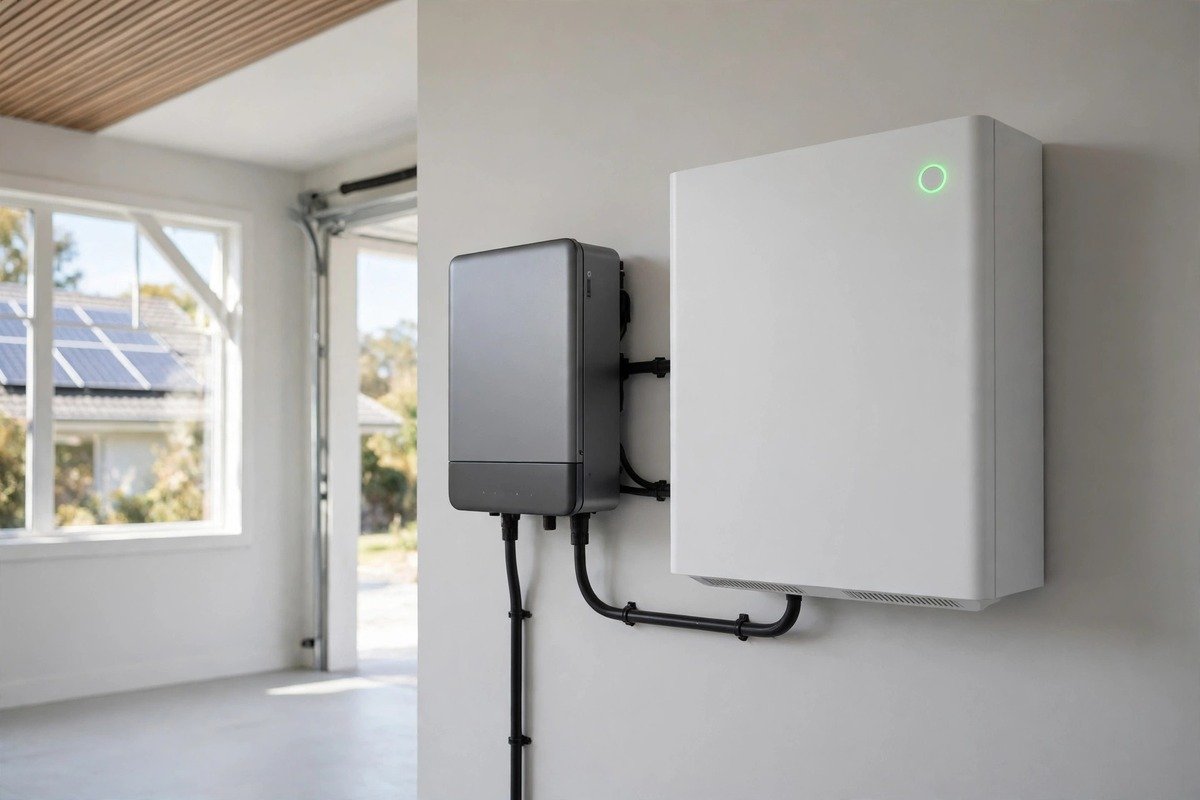
A home battery does one simple job: it holds the solar power your roof makes during the day and hands it back in the evening, when your household actually uses power and grid electricity costs the most. Then the federal government started paying about a third of the cost, and Australians bought batteries faster than anyone expected.
Home batteries are becoming more popular. The federal Cheaper Home Batteries Programme started on 1 July 2025 and early 2026 saw the Clean Energy Regulator report more than 284,000 installations. Rebate was tiered by battery size as of May 1, 2026. The regulator has also tightened safety checks on battery installs.
This guide explains how the rebate works, what a battery costs after the discount, which chemistry to pick, how to size one, and what to check before you sign. Prices and rebate rates move — check the current price before you pay.
How the Federal Rebate Actually Works
The federal Cheaper Home Batteries Program does not hand you a cheque. It works through small-scale technology certificates, or STCs — the same mechanism that has discounted rooftop solar for years. When an eligible battery is installed, it creates STCs. You assign the right to create them to your installer or retailer, and they pass the value on as an upfront discount on your invoice. The Clean Energy Regulator administers the scheme, and the government buys the certificates back.
The discount is meant to be around 30% of the installed cost. How many STCs a battery earns depends on when it is installed and how big it is. The STC factor — certificates per kilowatt-hour of usable capacity — steps down every six months. It was 8.4 from January to April 2026, and it is 6.8 from 1 May to 31 December 2026. It keeps falling every six months after that, to 2.1 in the second half of 2030, when the scheme ends. The installation date decides the rate, not the day you sign the contract.
Since 1 May 2026 the support is also tiered by size: the full factor applies only to the first 14 kWh of usable capacity, 60% applies between 14 and 28 kWh, and 15% between 28 and 50 kWh. Nothing above 50 kWh earns certificates. To be eligible, a battery must be 5 to 100 kWh in nominal capacity, on the Clean Energy Council’s approved product list, installed by a Solar Accreditation Australia installer with a battery endorsement, and capable of joining a virtual power plant if grid-connected. Only one battery per premises can claim the discount. Most home batteries are 10 to 15 kWh, so most households sit entirely in the full-rate tier.
What the Numbers Say So Far
The Clean Energy Regulator reported more than 284,000 validated batteries installed under the program by the first quarter of 2026, totalling 7.4 GWh of usable capacity. By 30 June 2026 the count had reached 478,176 batteries since 1 July 2025, or 13.58 GWh of storage. The Clean Energy Council’s half-year report put the first twelve months slightly lower, at 457,439.
Before the program, fewer than 5% of Australia’s 3.5 million solar homes had a battery. The government did not expect the rush: the program was announced with a $2.3 billion budget, and on 13 December 2025 it was expanded to an estimated $7.2 billion over four years.
LFP vs NMC: The Two Chemistries on Your Quote
Almost every residential battery quoted in Australia uses one of two lithium chemistries. LFP stands for lithium iron phosphate. NMC stands for nickel manganese cobalt. The decision is about safety, lifespan and space.
LFP is the safer chemistry for a home. Its thermal runaway threshold — the temperature at which a damaged cell can catch fire — sits roughly 60 to 120 degrees Celsius higher than NMC’s. Independent 2026 testing found thermal runaway roughly 80% less likely in LFP cells under equivalent abuse conditions. LFP also lasts longer: typically 3,000 to 6,000 charge cycles, against 1,000 to 2,500 for NMC, and it can be discharged to 95 or 100% of its capacity without complaint. NMC still wins on energy density, storing more kilowatt-hours per kilogram, so the same capacity fits in a smaller, lighter box. On a garage wall it decides very little, and the shorter cycle life means an NMC battery usually costs more per stored kilowatt-hour over its life.
Sizing a Battery for Your Home
The most common sizing mistake is buying the biggest battery on the quote. A battery only saves money on the power it actually moves from midday to evening, so the right size follows your evening usage, not your roof size. Start with your electricity bills: look at how many kilowatt-hours your household uses between about 4pm and 10pm on a normal day. A household that uses 8 kWh in the evening needs roughly a 10 kWh battery, allowing for conversion losses.
Two capacity numbers appear on every datasheet, and they are not the same. Nominal capacity is the size of the box. Usable capacity is what you can actually draw from it, after the depth-of-discharge limit. A 10 kWh LFP battery at 95% depth of discharge gives you 9.5 kWh. The rebate is calculated on usable capacity, and so is every saving estimate worth reading — so compare quotes on usable kilowatt-hours, not nominal ones.
Solar and Battery Together
The discount only applies to batteries installed with new or existing rooftop solar.
The pairing changes how much your solar is worth. Without a battery, surplus power goes to the grid for a feed-in tariff of only a few cents per unit, while you buy evening power for roughly 25 to 42 cents a unit, depending on where you live — those are the regulated 2026–27 residential benchmarks. A battery earns the gap between those two numbers on every unit it shifts. That gap is widest in South Australia and narrowest in Tasmania.
One condition catches people out: if the battery is grid-connected, it must be capable of joining a virtual power plant, or VPP. That does not mean you have to join one. Some VPP plans pay you for access, so read the terms before signing, because some plans take control of when your battery charges and discharges.
What It Costs and When It Pays for Itself
Installed prices fell about 20% through 2025 as volumes rose, and the rebate took another large slice off. Indicative national averages from mid-2026, after the federal discount, put a 10 kWh system at about $8,880 installed — those figures come from Energy Matters’ mid-2026 pricing guide and vary by brand, site complexity and the certificate price on the day. Ask every quote to show the discount as a separate line.
Payback depends on how much power you shift, not on the battery’s sticker price. A household moving 8 kWh of solar into the evening every day avoids roughly $1,000 to $1,500 of grid purchases a year. Most well-sized systems are seeing payback of six to eight years after the rebate. South Australia is shortest at five to eight years, Western Australia longest at eight to thirteen.
Safety: What the Regulator Found
The speed of the rollout worried the regulator, and it responded by inspecting far more installations than ever before. The Clean Energy Regulator completed a record 6,554 solar and battery inspections in the 2025–26 financial year. In February 2026 the regulator said it was ramping inspections up further.
The results, published in the regulator’s 2025–26 inspection report on 16 November 2026, are uncomfortable reading for the industry. Of 3,373 randomly selected battery installations, 61.19% were rated substandard and 0.95% — 32 systems — were rated unsafe. Only 37.86% were adequate.
Substandard does not mean dangerous. It means the installation had faults that need fixing, but the system could safely stay running — and the most common faults were missing or incorrect warning labels, followed by wiring and circuit-protection issues. The regulator found no issues with the battery hardware itself. Every problem came from installation practices and workmanship, including loose connections and faulty residual current devices. Unsafe systems were shut down on the spot. That is why checking the approved product list on the day of installation — not the day of the quote — is worth doing.
What to Check Before You Buy
Get three quotes, and make them comparable: same usable capacity, same chemistry, same warranty terms, and the discount shown as its own line. Confirm the battery and the inverter are both on the Clean Energy Council approved list, and confirm the installer holds Solar Accreditation Australia accreditation with a battery endorsement — both are conditions of the rebate, not nice-to-haves. Ask what happens in a blackout: not every battery provides backup power, and those that do need a separate backup circuit wired in, which costs extra.
Finally, read the VPP clause and the exit terms before you sign. Know who owns the certificates and what happens if you sell the house. And if the upfront cost is the blocker for a small business rather than a home, our guide to small business grants for 2026 lists funding that does not need repaying. The saving a battery delivers each year still needs somewhere to sit, so our guide to the best high-yield savings accounts for 2026 can help you pick an account that earns interest on it.
Frequently asked questions
How much is the federal home battery rebate worth?
It depends on the battery’s usable capacity and the installation date. From 1 May to 31 December 2026, each usable kWh earns 6.8 small-scale technology certificates for the first 14 kWh, and less above that. At typical certificate prices that is roughly $250 per usable kWh on the first 14 kWh.
What size home battery do I need?
Look at your evening electricity use, roughly 4pm to 10pm. A household using 8 kWh in the evening suits about a 10 kWh battery.
Is LFP or NMC better for a home battery?
LFP, for most homes. It is more thermally stable, lasts 3,000 to 6,000 cycles against 1,000 to 2,500 for NMC, and can be discharged almost fully. NMC is smaller and lighter for the same capacity. The federal rebate treats both the same.
How long does a home battery take to pay for itself?
Most well-sized systems pay back in six to eight years after the rebate, according to mid-2026 Australian pricing guides. South Australia is fastest at five to eight years and Western Australia slowest at eight to thirteen.
Are home batteries safe?
The batteries themselves have not been the problem. In the Clean Energy Regulator’s 2025–26 inspections, no faults were found in the battery hardware — the issues were installation workmanship. That is why an accredited installer matters more than the brand on the box.