A stone sold as a pet. A sponge with a smile. A blanket big enough to wear. These products sound like punchlines until someone starts taking orders. But looking at weird business ideas that made millions raises a more useful question than “How did anyone buy that?” What, exactly, did the customer believe was worth paying for?
Sometimes the answer is entertainment. Sometimes it is a small improvement to an ordinary task. And sometimes an unusual appearance makes a familiar product easier to recognize and remember.
The four examples below have documented evidence of substantial sales. Their results do not establish that being unusual causes success, but they offer useful ways to think about products, customers, and demand.
One distinction matters throughout: sales are not profit. Revenue does not tell us how much a founder took home after manufacturing, advertising, shipping, wages, and other expenses.
Who this guide is for
This guide is for readers exploring unusual consumer products and small-business owners deciding what to investigate with a limited test. It is most useful before committing to a large inventory order or marketing campaign.
It is not a launch plan, a product endorsement, or a forecast of earnings. If you need dependable income immediately, cannot absorb the cost of a failed test, or need to borrow money to pursue an unvalidated idea, these success stories are not enough to support that decision. Products involving health, children, food, or other safety-sensitive uses also need specialist assessment beyond this article’s scope.
The numbers behind the unusual ideas
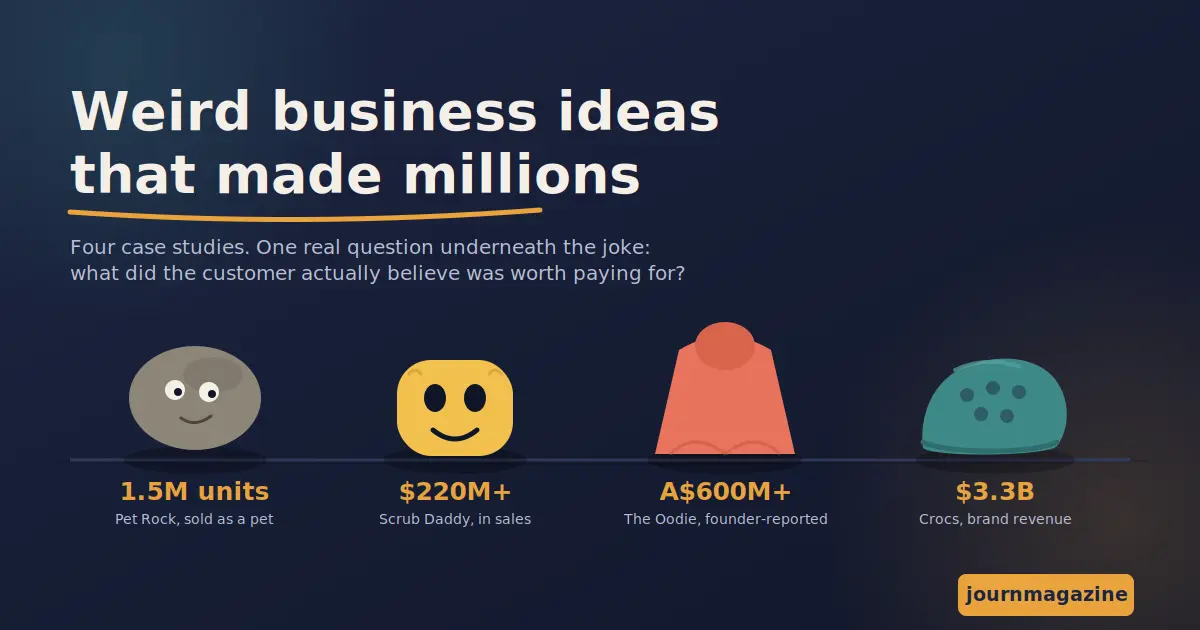
These are selected historical milestones, not a ranking of current business performance. Each source is linked in the corresponding case study.
| Business | Unusual offering | Reported evidence of scale | How to interpret it |
|---|---|---|---|
| Pet Rock | A packaged stone presented as a pet | About 1.5 million units at a US$3.95 retail price during the original craze | Roughly US$5.9 million in implied retail value, not verified founder profit |
| Scrub Daddy | A smiling, texture-changing cleaning sponge | More than US$220 million in company revenue in 2023, according to Reuters sources | Annual company revenue across its product range |
| The Oodie | An oversized wearable blanket | More than A$600 million in sales, according to its founder in an October 2024 Forbes Australia profile | Cumulative, founder-reported sales; not an audited profit figure |
| Crocs | Distinctive casual footwear | Approximately US$3.278 billion in Crocs Brand revenue in 2024 | Annual brand revenue, excluding the separate HEYDUDE brand |
1. Pet Rock: A gift whose value was the reaction
Gary Dahl launched Pet Rock in 1975. The package paired a stone with a cardboard carrier and a humorous instruction manual. The Washington Post reported sales of about 1.5 million units at US$3.95 each. Multiplying those figures gives approximately US$5.9 million in retail value, although it does not establish Dahl’s own revenue or profit. Source: The Washington Post
A plausible reading of the product is that customers were buying an occasion to laugh. Comparing its price with the cost of an ordinary stone can miss that purchase motive. A novelty gift competes for a gift budget, where surprise and presentation may matter as much as practical usefulness.
For a small business, this suggests a specific research question: Who would give this to whom, and on what occasion? “People who like funny things” is a vague audience. “Colleagues buying an inexpensive farewell gift” gives you a buyer, a moment, and a reason to purchase.
There is also a limit. A successful joke does not automatically create repeat customers. Before producing a large batch of a novelty item, consider whether someone would buy it again for another recipient, or whether the first purchase exhausts the appeal.
A test to try: Show a finished sample, including its packaging and intended price, to prospective gift buyers. Ask when they would buy it and what they would otherwise choose. A laugh is encouraging; a purchase at the intended price is stronger evidence.
2. Scrub Daddy: A playful design with something to demonstrate
Scrub Daddy makes the familiar kitchen sponge visually distinctive. Its signature material changes firmness with water temperature, giving the product a feature customers can see in action. Source: Scrub Daddy
Reuters reported that the company generated more than US$220 million in revenue in 2023, citing people familiar with the business. The report also described a range of around 160 products, so that revenue should not be attributed to a single sponge design. Source: Reuters, March 2024
The useful distinction here is between a product that looks interesting and one that gives the seller something concrete to demonstrate. A face may make a cleaning tool memorable. A visible change in how it behaves provides a separate reason to investigate it.
That combination is worth considering when developing an unusual product. Can you show the benefit in a short demonstration? Can someone explain what it does after watching once? If the explanation depends on a long list of adjectives, the advantage may need to become clearer.
Demonstrations still need to reflect normal use. A carefully staged result can attract an initial order while setting expectations the product cannot meet.
A test to try: Give a prototype and an ordinary alternative to several intended users. Let them perform the same task with each, then ask which they would choose at the proposed prices. Record their reasons before explaining your preferred selling points.
3. The Oodie: Making comfort easy to picture
The Oodie built a brand around an oversized, hooded wearable blanket. In an October 2024 Forbes Australia profile, founder Davie Fogarty said the business had generated more than A$600 million in sales since its launch in 2018. That is a cumulative founder claim, not evidence of A$600 million in profit. Source: Forbes Australia
The product illustrates how an unusual shape can communicate a familiar benefit. A shopper can picture settling into a sofa on a cold evening without needing a technical explanation of what a wearable blanket is for.
For another business, the practical question is whether the product fits a recognizable moment in someone’s day. Showing an item in use may answer questions that a photograph against a plain background cannot: How large is it? Where does it fit? What does owning it feel like?
The less visible work matters too. In a 2023 article, Fogarty discussed challenges including fulfillment, customer experience, and competition. Those operational concerns are a useful counterweight to the idea that a memorable product sells itself. Source: Fogarty’s account in SmartCompany
A test to try: Photograph your product in two realistic use situations and ask prospective customers which one fits their lives. Then investigate the practical objections: storage, cleaning, delivery cost, sizing, or durability. Those answers can improve both the product and its description.
4. Crocs: Commercial success at a scale far beyond a novelty
Crocs reported approximately US$3.278 billion in Crocs Brand revenue for 2024. Its results distinguish that figure from total company revenue, which also includes HEYDUDE. The brand sold through both direct channels and wholesale partners. Source: Crocs’ 2024 results
The lesson here concerns the limits of judging a business idea by appearance. An unconventional product can still attract a substantial customer base. Personal taste is a poor substitute for finding out what actual buyers value.
This does not mean every unpopular design is an undiscovered opportunity. It means criticism needs to become more specific. Does someone dislike the appearance but value the function? Do they find the product uncomfortable? Is the price wrong? Those are different problems with different possible responses.
Crocs also provides a useful reminder about scale. Revenue from an established international brand does not tell a new seller how cheaply they can acquire a customer or how much inventory they should order. The early task is to establish a reason to buy within a reachable audience.
A test to try: Separate feedback from intended customers and casual observers. Ask each group what they would use the product for and what would stop them buying. Give greater weight to concrete purchase objections than to general approval or mockery.
What these examples suggest—and what they cannot prove
The interpretation offered here is that each product has an understandable purchase motive beneath its unusual presentation: a funny gift, a cleaning benefit, comfort, or a footwear preference. Establishing which motive actually drove purchases would require customer research.
That is a useful starting point for developing an idea. Write down the customer’s reason to buy before writing a clever brand slogan. If that reason is difficult to explain, additional novelty may only make the offer more confusing.
These examples also suffer from survivorship bias. We are examining businesses that became visible because they succeeded. Without studying comparable failures, we cannot calculate the chances that another unusual product will work or identify one guaranteed cause of success.
Use the stories to generate questions you can test, rather than revenue forecasts you can borrow.
How to test an unusual business idea before scaling
Identify a buyer and a buying moment
Describe one situation where someone would spend money on the product. A specific occasion makes it easier to choose a design, price, and place to reach the customer.
Find out what the customer already uses
The alternative might be a competing product, a homemade solution, or simply doing nothing. Ask what would make changing worthwhile. This can reveal whether your idea offers meaningful value or only a different appearance.
Calculate what remains from each order
Start with the selling price and subtract product cost, packaging, payment fees, shipping you cover, and expected returns. Then account for the cost of obtaining the order.
For example, a hypothetical US$25 product with US$15 in those variable costs leaves US$10 before customer acquisition. Spending US$8 to obtain the sale leaves US$2 to contribute toward overhead and profit. Whether that is sufficient depends on the remaining costs and time involved.
Include an allowance for your own production or fulfillment time. Unpaid owner labor can make an offer appear more attractive than it is. Also distinguish a margin calculation from cash flow: a supplier may require payment before you receive money from customers.
Run a small, honest sales test
Offer a limited batch you can fulfill. If delivery timing or production remains uncertain, start with nonbinding expressions of interest instead of taking payment, while recognizing that interest is weaker evidence than a purchase. Use preorders only when you can explain the terms and meet the commitments you make.
Track paid purchases, cancellations, returns, and customer questions. Record how buyers found you and whether they received discounts. Orders from friends or a heavily discounted launch may not represent demand from unfamiliar customers at your normal price.
Decide what would justify the next batch
Set your criteria before looking at the results. You might require a workable margin, manageable fulfillment time, and evidence that customers understand the product. If those conditions are missing, revise the offer before increasing spending.
A practical decision framework: proceed, revise, or pause
Use these checkpoints in order. They are prompts for judgment, not a validated scoring model or universal success benchmark.
| Checkpoint | Evidence to look for | If the evidence is missing |
|---|---|---|
| Buyer and occasion | Intended buyers can explain when they would use or give the item | Narrow the audience and investigate the occasion before ordering stock |
| Willingness to pay | Purchases at a price you could continue charging, with discounts recorded | Test the offer or audience; do not treat attention as proof of demand |
| Contribution per order | Money remains after variable costs and acquisition, with labor accounted for | Revise price, costs, or design before buying more traffic |
| Delivery and product quality | The sample performs as described and a small batch can be delivered as promised | Pause expansion and resolve the failure |
| Ability to repeat the result | Demand appears beyond one event, friend group, or promotional spike | Treat the result as provisional and run another bounded test |
Proceed with another small test when these checks are supported and you can afford the downside. Revise when customers value the product but a specific issue, such as packaging cost or unclear sizing, prevents a workable offer. Pause when the economics remain negative or quality and delivery problems are unresolved. A strong result in one area does not cancel a failure in another.
A realistic scenario: the gift people like but barely pays
Hypothetical example—all numbers are illustrative, not industry benchmarks. Suppose a seller tests 20 personalized desk gifts at US$25 each. All 20 sell, and the buyers initially seem happy. The seller’s records show:
| Item | Per order | Total for 20 orders |
|---|---|---|
| Sales revenue | US$25 | US$500 |
| Materials and production | US$7 | US$140 |
| Packaging | US$2 | US$40 |
| Payment fees | US$1 | US$20 |
| Shipping paid by seller | US$4 | US$80 |
| Allowance for refunds or replacements | US$1 | US$20 |
| Customer acquisition | US$8 | US$160 |
| Contribution before owner labor and fixed costs | US$2 | US$40 |
If each order takes 15 minutes to personalize and pack, the batch requires five hours. Valuing that time at an illustrative US$12 an hour adds US$60 in labor cost. The batch then has a US$20 shortfall before fixed costs and taxes. The refund allowance is an estimate; actual outcomes could be better or worse.
Selling out establishes some willingness to buy at the tested price. It does not yet establish a sustainable business.
The seller could test a higher price, simplify personalization, or investigate lower-cost packaging that still protects the item. Each option has a tradeoff: a higher price may reduce demand, less customization may reduce appeal, and weaker packaging may increase damage. Change one main variable at a time so the next result is easier to interpret.
Common mistakes to avoid
- Treating compliments as orders. Record actual purchasing behavior separately from favorable reactions.
- Assuming a first batch predicts the year. A small test may depend on a holiday, a local event, or personal contacts. Check whether the same buying situation exists again.
- Forgetting labor and after-sales work. Time spent on personalization, delivery questions, refunds, and replacements belongs in the evaluation.
- Assuming future repeat purchases will rescue today’s losses. Use repeat-purchase assumptions only when you have evidence for them. A one-time gift can still work, but its economics need to reflect that purchase pattern.
- Ordering many variants too early. A popular design does not establish demand for every color, size, or message. Test additional variants before expanding inventory.
- Mistaking brand sales for product-level profit. A large company’s revenue may cover many products and channels. It does not reveal the margin on the item that inspired you.
Troubleshooting a small product test
These are possible explanations to investigate, not diagnoses you can make from one metric.
| What you observe | Possible explanation | What to check next |
|---|---|---|
| Many views, few visits to the product page | People enjoy the content but do not understand or want the offer | Ask intended buyers what they think is being sold and why they would need it |
| Product-page visits but few orders | Price, delivery terms, unclear details, audience mismatch, or a technical problem | Test checkout yourself and ask prospective buyers what stopped them; do not assume price is the cause |
| Orders arrive, but cash runs short | Inventory payments, shipping, refunds, or payout timing consume cash | Reconcile cash received and bills due separately from the margin calculation |
| Buyers say the item differs from expectations | Photos, descriptions, sizing, or demonstrations may be misleading | Compare the actual product with the promise and correct the mismatch before promotion |
| Sales work only with deep discounts | The full-price offer may not justify its cost to buyers | Recalculate contribution at the discount price and test a clearer benefit or different offer |
| One burst of orders is followed by silence | An event, gift occasion, or publicity spike may have driven demand | Identify where those orders came from and whether that source can recur |
| More orders produce more complaints | Quality checks, packing, or delivery capacity may be stretched | Limit incoming volume while you identify and resolve the bottleneck |
Before a test, decide how much money and time you can lose without affecting essential obligations. Stop or revise when that limit is reached. Increasing spending simply because a famous brand succeeded is not evidence that your own offer will improve.
Questions readers often ask
Can a strange idea become a serious business?
Yes. The examples above document substantial commercial activity. But novelty is only one feature of an offer; customers still need a reason to pay the price you charge.
Does “made millions” mean the founder became a millionaire?
Not necessarily. Product sales, company revenue, business valuation, and personal wealth describe different things. This article identifies the measure behind each example instead of treating them as interchangeable.
Do you need to invent a completely new product?
An opportunity can begin with an improvement to something familiar. The important question for an initial customer test is whether buyers prefer your offer enough to pay for it.
Start with the purchase, then develop the personality
Weird business ideas that made millions are entertaining to read about because their products challenge our expectations. Their practical value is in the questions they prompt.
Who is the buyer? What makes this worth paying for? Can the promise survive ordinary use? Does enough money remain after delivering the order?